Every leadership team wants the same thing.
Clear priorities. Teams that take ownership. Projects that move forward without constant chasing. Objectives that actually get achieved.
So here's a statistic that's worth paying attention to.
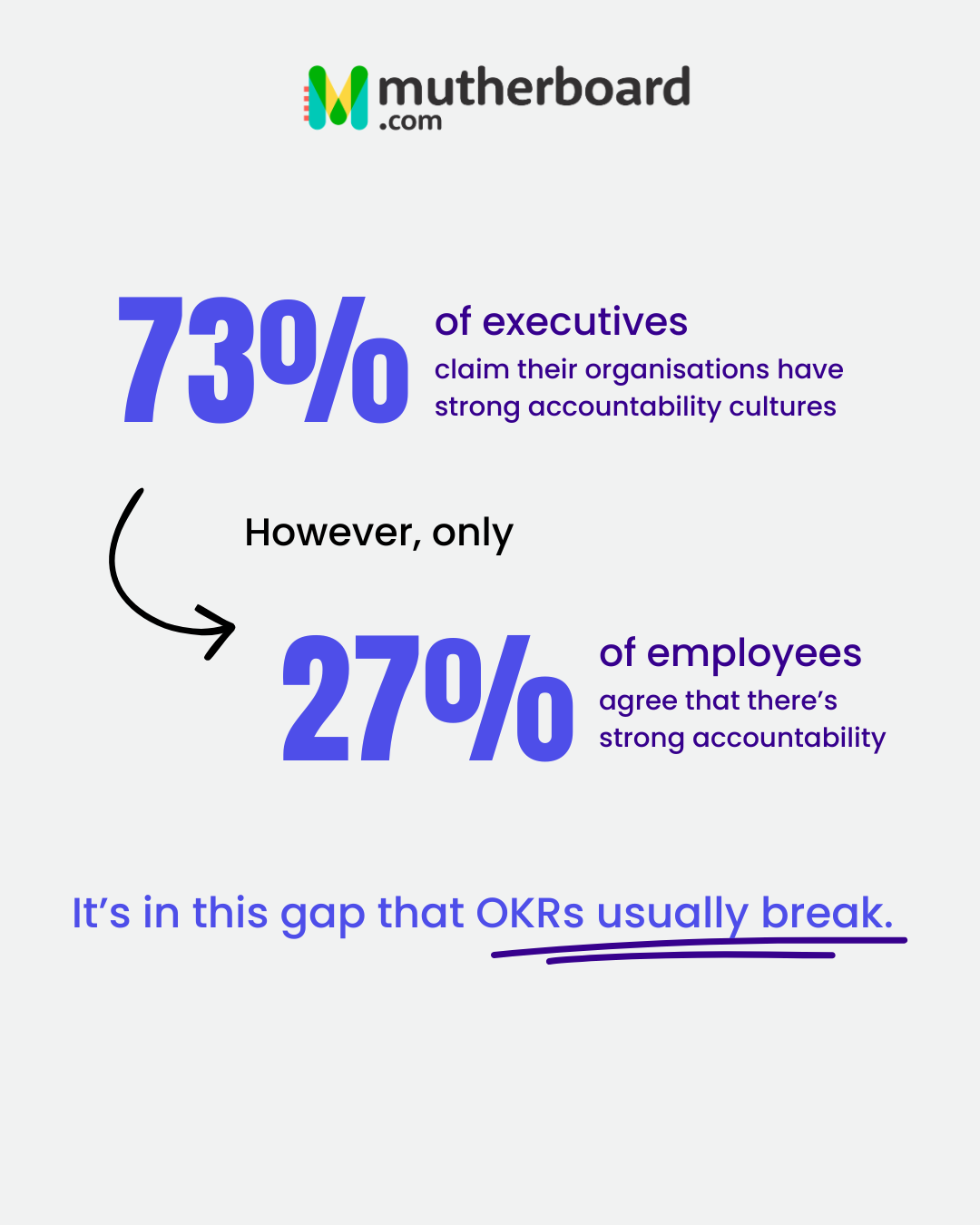
73% of executives believe their organisation has a strong culture of accountability.
Yet only 27% of employees agree.
That is not just a difference of opinion. It is a warning sign.
It tells us that somewhere between strategy and execution, expectations are getting lost.
Accountability isn't about working harder
When people hear the word "accountability," they often picture performance reviews, status meetings, or someone checking whether tasks have been completed.
But real accountability looks very different.
It means every person understands:
- What they're responsible for.
- Why their work matters.
- How success is measured.
- Who they collaborate with.
- What happens next if something changes.
Without that clarity, accountability becomes reactive instead of proactive.
People spend more time asking questions than making progress.
This is where OKRs start to fail
Most organisations don't struggle because they set bad objectives.
In fact, leadership teams often create thoughtful, ambitious OKRs.
The challenge comes later.
As work flows through different departments, priorities shift, projects evolve, and information becomes fragmented.
Marketing has one view.
Operations has another.
Finance is tracking different numbers.
Project managers are updating one system while teams are communicating somewhere else entirely.
Eventually nobody is certain whether the organisation is actually making progress toward its objectives.
The OKRs haven't failed because they were unrealistic.
They have failed because visibility disappeared.
The hidden cost of poor visibility
When accountability isn't shared across the organisation, several things begin to happen.
Projects slow down because people are waiting for answers.
Managers spend their time chasing updates instead of removing blockers.
Teams duplicate work because they cannot see what others are doing.
Priorities constantly compete with each other.
Reporting becomes manual.
Decision making becomes slower.
People become frustrated because they feel disconnected from the bigger picture.
Ironically, leadership may still believe accountability is strong because they can see strategic plans and executive dashboards.
Employees, however, experience something completely different.
They experience uncertainty.
Technology should reduce uncertainty
Adding another spreadsheet rarely fixes the problem.
Neither does another weekly meeting.
Strong accountability comes from giving everyone access to the same source of truth.
That means:
- Clear ownership for every initiative.
- Connected systems that eliminate duplicate work.
- Automated updates instead of manual reporting.
- Real time visibility into progress.
- Objectives that link directly to the work teams are doing every day.
When people can see how their work contributes to company goals, accountability becomes something they naturally take ownership of.
Building accountability into the way work happens
This is exactly why organisations invest in better operational systems.
At Mutherboard, we help businesses connect their processes, automate repetitive work, and create visibility across projects, resources, and objectives.
Whether that means integrating your existing tools, improving project management, or implementing smarter workflows, the goal is always the same.
Make it easier for people to know what they own, what matters most, and what needs attention next.
Because accountability should never depend on someone's memory or another follow up email.
It should be built into the way your business operates.
The gap between 73% and 27% is bigger than a statistic.
It represents the space where projects stall, teams become disconnected, and OKRs lose momentum.
Close that gap, and accountability stops being something you talk about.
It becomes something your entire organisation can see, measure, and act on every day.