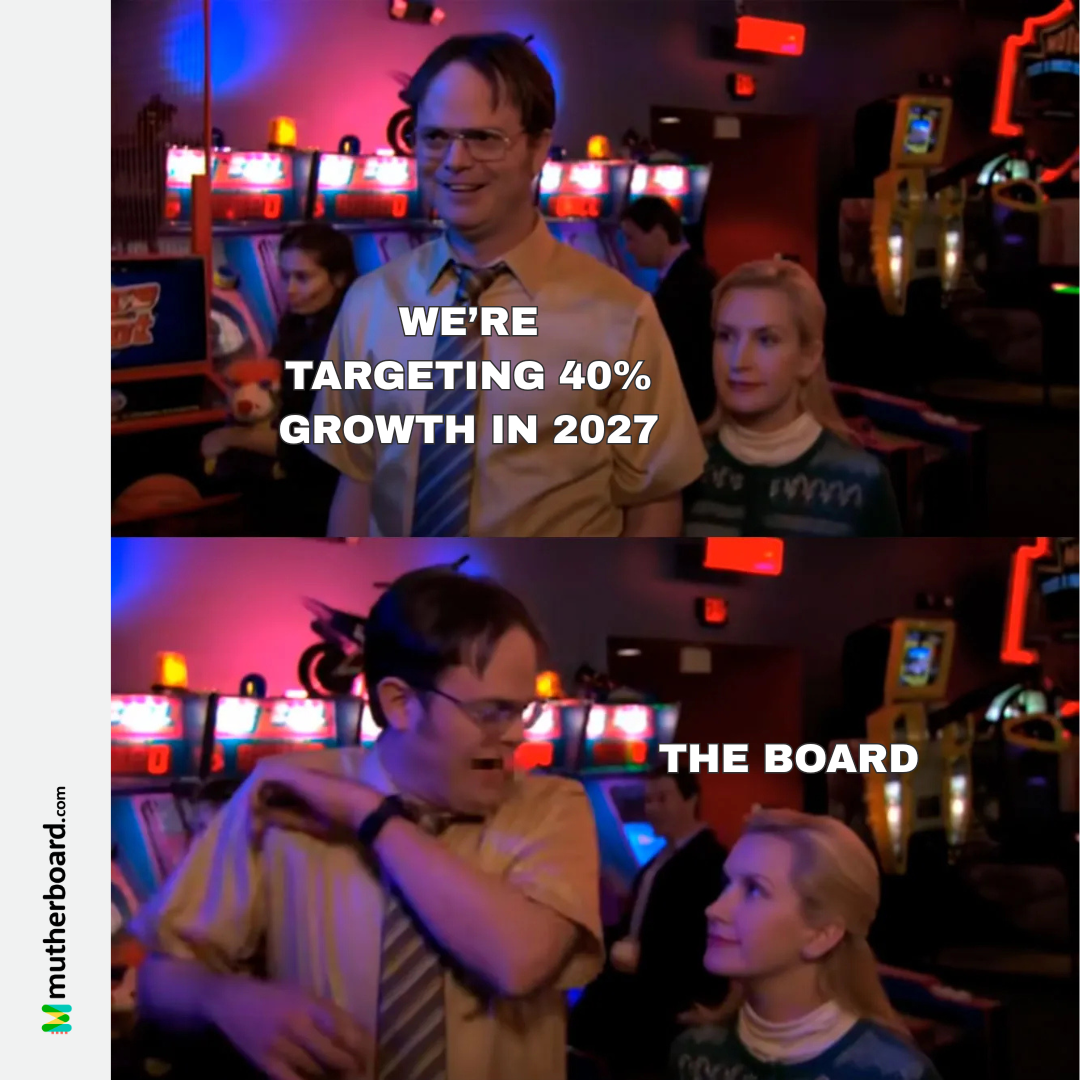
“We’re targeting 40% growth in 2027.”
It sounds impressive in a boardroom. It looks even better on a strategy presentation. Everyone nods, the targets are agreed, and the business is officially on its way to bigger and better things.
But there is one small detail that can turn an ambitious growth target into a very expensive headache.
Who is going to do the work?
Because while revenue targets are often set with confidence, the capacity required to achieve them is not always given the same attention. And if your growth strategy does not account for the people, time, skills and resources needed to deliver it, you may be setting your business up for a very different kind of growth.
The kind where your pipeline is thriving, your delivery teams are drowning, and your profit margins are quietly disappearing.
Growth is not just a sales target
It is easy to focus on the numbers that are most visible. Revenue, new clients, sales opportunities and market share are all important indicators of business performance.
But growth does not happen in isolation.
Every new client needs to be onboarded. Every new project needs to be delivered. Every additional commitment places demands on the people and resources already working hard to keep the business running.
A 40% increase in revenue could mean a 40% increase in delivery demand. Depending on the type of work, the complexity of projects and the way the business operates, it could mean even more.
And that is before accounting for the work already in progress.
If your teams are operating at 90% capacity today, where will the additional capacity come from? If you need specialist skills to deliver new projects, do you have those skills available? If you plan to hire, how long will it take to recruit, onboard and get those people productive?
These are not questions to answer once the business has already secured the work.
They are questions that should shape the growth strategy from the beginning.
The hidden cost of an ambitious target
When capacity is not properly costed, businesses often fall into one of three traps.
1. Hiring reactively
The business wins more work than expected, so the immediate solution is to hire more people.
But recruitment takes time. New team members need onboarding, training and support. In the meantime, existing employees absorb the additional workload.
The result? A period of overcapacity, rushed recruitment and potentially higher costs than originally planned.
2. Stretching existing teams too far
Perhaps the business decides it can deliver more with the team it already has.
At first, this might seem like a sensible way to protect margins. But when people are consistently overallocated, the cracks begin to show.
Deadlines slip. Quality suffers. Burnout increases. The people you rely on most become the people most likely to leave.
And replacing experienced employees is rarely a cheap or straightforward exercise.
3. Taking on work that looks profitable but isn't
A project might look attractive from a revenue perspective, but what happens when you factor in the actual resources required to deliver it?
If the work demands specialist skills, additional contractors or more hours than expected, the margins can quickly shrink.
Without a clear understanding of resource costs, businesses risk winning work that contributes far less to profitability than anticipated.
The uncomfortable truth is that more revenue does not automatically mean more profit.
Capacity planning needs to happen before the commitment
A growth strategy should not simply answer the question, “How much do we want to grow?”
It should also answer, “What will it take to get there?”
This means understanding the relationship between sales forecasts, project demand, resource availability and delivery costs.
For example, if your business is targeting 40% growth, you need to understand:
-
How much additional project demand will that create?
-
Which teams will be responsible for delivering the work?
-
What skills will be required, and where are the current gaps?
-
How much capacity is already committed to existing projects?
-
Will you need to recruit, bring in contractors or change how work is delivered?
-
What will those additional resources cost?
-
At what point will you need to make those investments?
These questions help turn a high-level growth ambition into an operational plan.
They also give leadership teams something much more useful than a target alone: a realistic understanding of what the business needs to achieve it.
Your people are not an unlimited resource
One of the biggest mistakes businesses make is treating resource capacity as though it is a simple calculation.
If you have ten people working 40 hours a week, that is 400 hours of potential capacity.
Except it isn't.
People have meetings, administrative responsibilities, holidays, training, internal projects and unexpected challenges. They also need time to think, solve problems and do their jobs properly.
Not every working hour is a billable or project-delivery hour.
And not every employee can be moved between projects as though they are interchangeable.
A resource plan needs to account for the reality of how people work, including their availability, skills, experience and existing commitments.
This is particularly important for businesses that rely on specialist knowledge. You might have plenty of available hours on paper, but if the only person with the required expertise is already committed to three projects, your capacity problem is very real.
Understanding these constraints early allows businesses to make better decisions about hiring, project scheduling and the work they choose to accept.
Visibility is what makes growth manageable
This is where resource management becomes a strategic business function rather than an administrative exercise.
When leadership teams have visibility into resource availability, project demand and future requirements, they can make informed decisions about growth.
They can identify resource bottlenecks before they become delivery problems. They can see where teams are underutilised and where additional support is needed. They can forecast future demand and understand the financial implications of different growth scenarios.
Most importantly, they can make decisions based on what is actually happening across the business, rather than relying on assumptions or spreadsheets that were already out of date when they were shared.
Good resource management connects the dots between what the business wants to achieve and what it has the capacity to deliver.
It helps answer the questions that matter:
Can we take on this new project?
Will we need to hire before the next quarter?
Are we using our existing resources effectively?
What happens to our margins if delivery costs increase?
Can we achieve our growth target without putting unnecessary pressure on our teams?
These are the questions that allow businesses to grow with confidence.
Growth should be ambitious. Delivery should be realistic.
None of this means businesses should set smaller targets or avoid ambitious growth plans.
Quite the opposite.
Ambition is important. Businesses need to challenge themselves, identify opportunities and push towards meaningful goals.
But ambition without operational planning is just optimism with a spreadsheet.
The businesses that grow sustainably are the ones that understand what growth demands from them. They know where their capacity sits today, what they will need tomorrow and how much it will cost to bridge the gap.
They do not wait until their teams are stretched beyond their limits to start thinking about resources.
They plan ahead.
Because the real measure of a successful growth strategy is not simply how much new business you win. It is whether you can deliver that work profitably, consistently and without burning out the people responsible for making it happen.
So, the next time someone announces a 40% growth target, by all means, celebrate the ambition.
Just make sure someone has costed the capacity to deliver it.
At mutherboard, we help businesses bring visibility to their projects, people and processes, so that growth is supported by the right systems, the right resources and a plan that works in the real world.
Because your board might love a big number.
Your delivery team will love a realistic plan even more.
Ready to make your growth strategy work in practice? Let's talk about how better resource management can help you plan capacity, protect margins and deliver with confidence.